

The world is moving so fast, and people have no patience to wait for a lot of time to get what they want. The scenario of the fast-paced world of 2026 online gaming is no different.
Even though the online gambling sector has moved far forward in 2026, some things cannot be made quicker; sometimes waiting for a certain period can only bring a positive impact, and we explore why first-time PayID deposits take a 24-hour hold when making their first deposit at a new casino like Wild Tokyo or Lucky 7 in this fast-paced new era of online gambling.
The answer is simple: this is not a glitch or technical error; it is an advanced security protocol generally referred to as the “Initial Trust Handshake” in the banking world. For more payment guides, casino reviews, and banking tips, visit AUPokieHub.
The 24-Hour Hold : How The Big Four Banks Regulate New Payments
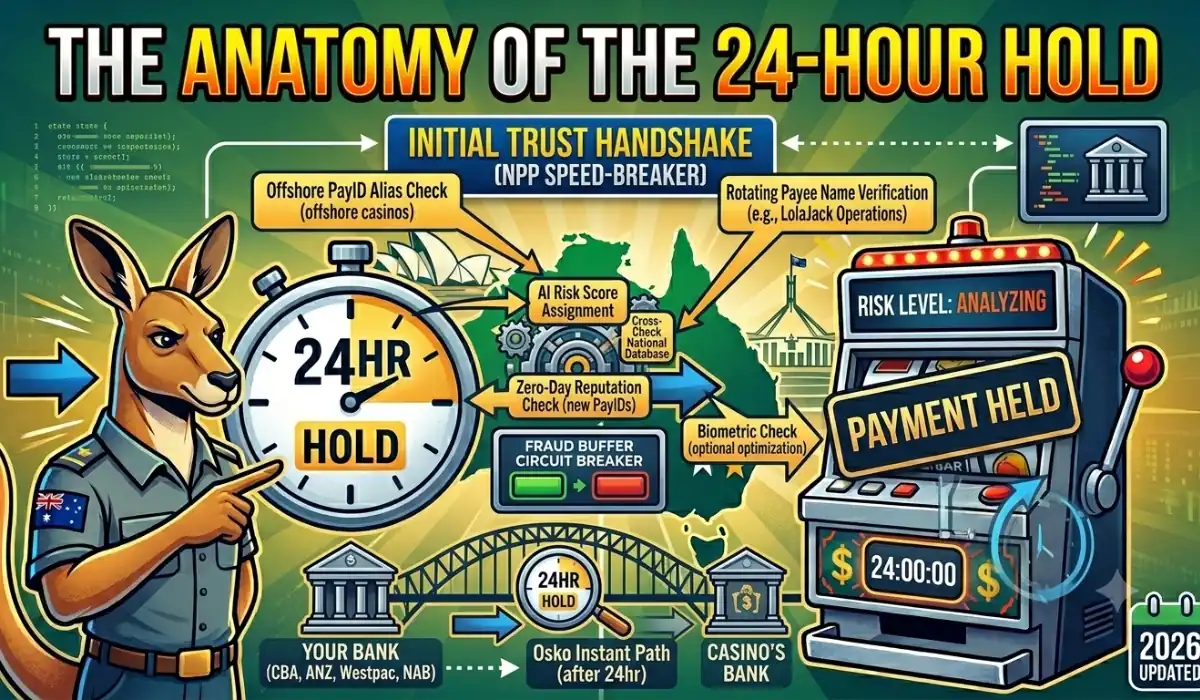
The NPP Speed Breaker: Why Commonwealth Bank, ANZ, Westpac, and NAB Delay First-Time Transfers
In Australia, the NPP (New Payments Platform) is designed for speed, but for the new connections, there will be some exceptions.
The major Australian banks, like CBA, ANZ, Westpac, and NAB, have integrated a speed breaker to slow down the process and conduct a detailed security check for the initiated connection. This speed breaker is called the 24-hour hold or the ‘initial trust handshake’.
The Fraud Buffer: How The 24-Hour Delay Acts as Scam Circuit Breaker
This 24-hour delay is basically acting as a circuit breaker to provide these banks enough time to clarify that your account hasn’t been compromised, and it is also to give you a cooling-off period to report a mistake or a scam.
Technically, this delay can be called the fraud buffer, since it ensures that your account is free from any malicious behaviour and ready to initiate a connection.
During this waiting period, the bank’s security system conducts a background verification or a “handshake” with the recipient’s financial institution.
This verification is to make sure that the PayID is linked to an authentic, legitimate and verified entity. During this period, you will also get a “New Payee” notification, and you can cancel the transaction if you were not the one who initiated it. Similar verification checks may also apply at some credit card casinos, particularly when a new payment method is used.
The “Initial Trust Handshake” Explained: The Math Behind The Banking Hold
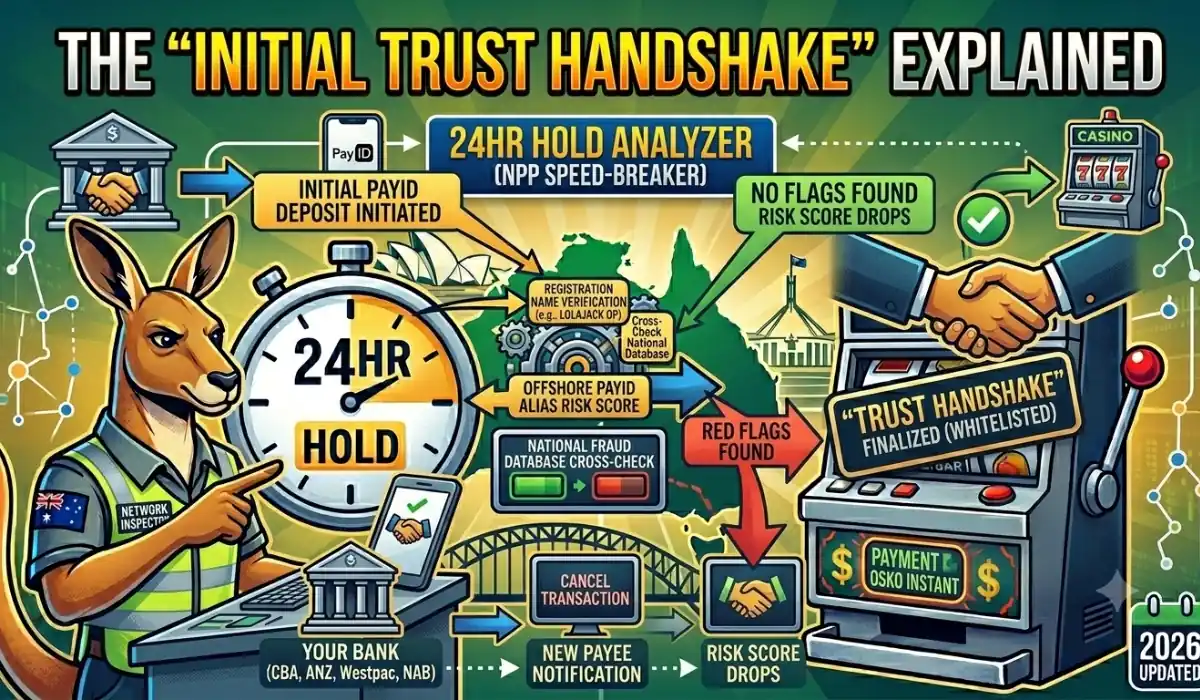
The initial trust handshaking is not just a metaphor; it is a perfectly built and executed payment mediator that connects the speed of the NPP with the caution of traditional Australian banking. Because this is a digital introduction, it needs to follow safety rules, especially now, when online payments are often targeted by scams.
Automated Risk Scoring: Why Rotating Offshore Casino PayID Aliases Trigger AI Red Flags
In the initial trust handshake process, verification of the payee is the first step. When you enter a PayID and register for the first time, the system shows you the registered name (e.g., “LolaJack Operations”). After that, you are prompted to hit “send”, and once you hit the send option, the bank initiates the handshake. After initiating the process, the bank’s AI software assigns the destination based on a risk score, and this is because offshore casinos use rotating PayID aliases to stay ahead of ISP blocks.
As per the system, the 24-hour duration allows the AI to cross-check the new PayID against a national database. If any red flags were not found within this time period, the risk score drops, the first payment clears, and the process of “Trust Handshake” is finalised.
Once you complete the 24-hour delay, your bank trusts this route, and next deposits to the same PayID will drop to instant (Osko) speeds. Many players use PayID pokies for fast deposits, but some are surprised when their first transfer triggers a temporary security hold.
Here is a table that compares the first deposit and every deposit after.
|
Comparison features |
First Deposit |
Every Deposit After |
|
Speed |
~24 Hours |
< 60 Seconds (Instant) |
|
Banking Protocol |
Initial Trust Handshake |
Osko / Fast Settlement |
|
Verification |
Full Security Handshake |
Identity Match Only |
|
Status |
Pending or “Held” |
Completed |
To understand this concept, we can rely on a simple example. Think of your bank and the casino’s bank as two ends of a newly built bridge.
The first time you send money through this bridge, the concerned authorities will check the strengths of this bridge to make sure that everything is okay and stable. The hold can occur regardless of whether you’re making a large transfer or using minimum deposit casinos that accept small initial deposits.
This inspection period is the 24-hour hold, and once you complete this inspection period and your first payment lands successfully, the bank whitelists your connection, and from then on, you will be able to enjoy the speed of NPP.
How To Skip The PayID Hold: Speeding Up Instant Casino Deposits in 2026
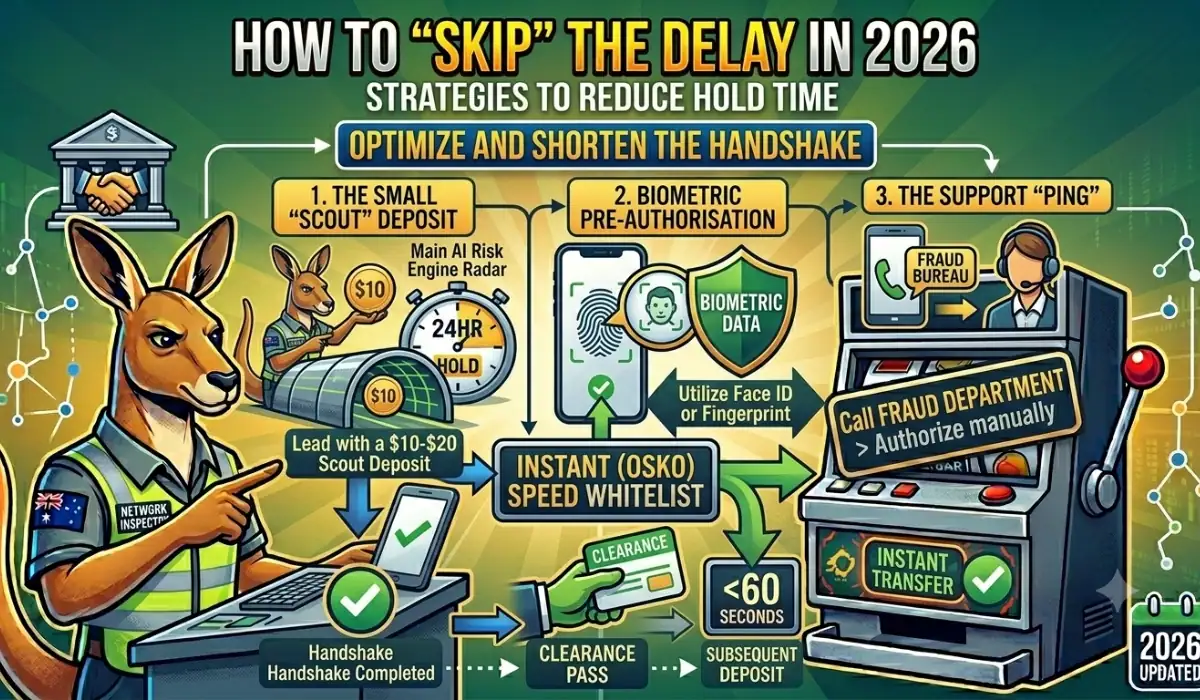
Australian punters need to know one thing: you can’t always jump across the bank’s security. What you can always do is optimise the process. In 2026, the 24-hour hold is a standard gatekeeper protocol that removes all risk factors.
However, the 24-hour hold is an inevitable process; you can ease it by providing the bank with the necessary data to lower the risk score. Here are some strategies you can adopt to skip the delay and make the process quicker.
1. The Small “Scout” Deposit: $10 to $20 Payments Under the AI Risk Radar
While depositing, you should not lead with your full bankroll and don’t start with a $500 transfer. Send a small scout deposit (between $10 and $20), because this kind of deposit generally stays under the high-priority radar of the AI risk engine.
The major benefit of this is that even if the 24-hour hold triggers, you have only tied up a small portion of your funds. Once the scout deposit clears, the initial trust handshake is complete, and your following larger deposits will move quickly, and you can enjoy Osko speed.
2. Biometric Pre-Authorisation: Using Face ID To Prove Real-Time User Intent
It is one of the highly beneficial features in modern-day gambling. If your bank supports Face ID or fingerprint verification and the bank’s official application is compatible with these biometric authentication methods, you can use them to reduce hold time.
Biometric authentication provides an extra layer of proof that lets the bank know that there is an actual person behind the transaction, and he is the one clicking the “Send” button.
3. The Support “Ping”: Requesting a Manual Bank Override
It is a form of manual override, which means that if your deposit has been pending for more than two hours, you can directly call the bank’s fraud department and verbally authorise the transaction.
Once they verify your identity through the phone, they can confirm the transaction and break the hold manually. While contacting the customer service, do not call general customer service; ask for the Fraud Bureau Service.
These are some of the important practices that you can adopt to reduce the 24-hour hold and enjoy quick transaction completion in this fast-paced world. If you are attempting to bypass this technical delay, do not try any third-party tools claiming to reduce bank holds.
In 2026, phishing scams have risen at an enhanced rate, so avoiding these kinds of activities will only help you in your gambling journey.
Why New Online Casinos Trigger Longer PayID Verification Holds?
The Zero-Day Reputation Problem: How The NPP Network Rates New Merchant ABNs
People often wonder, even with these advanced technologies, why online casinos trigger longer holds. The answer is simple: it is always better to double-check or verify deeply when they accept a new user or entity into their infrastructure.
In 2026, newer platforms like VegasNow or LolaJack use the “Initial Trust Handshake”, and they are on the verge of using brand-new PayID emails or ABNs that haven’t been “seen” by the Big Four banks yet.
The Centralised Fraud Database: Why Brand-New PayID Emails Face Stricter Scrutiny
The zero-day reputation problem is a factor in why the 24-hour hold exists in the online gambling sector. If you are a new PayID merchant, you have a zero-trust rating, and big banks like CBA, NAB, ANZ, and Westpac have a centralised fraud database, and what they do is cross-check the ID. According to them, a new merchant PayID must process thousands of clean transactions to gain a high trust rating across the NPP network.
In this fast-paced world, sometimes, it is better to wait for a little time, because when you play at a new site for the first time, a delay is a signal that the bank’s NPP security layer is maximising its efforts to protect your funds to ensure a seamless gambling experience without any further problems.
Make sure both your bank and the casino show the Osko logo. If either one doesn’t support it, the payment will switch to a standard transfer, which usually takes 1–3 days, no matter what the ‘Handshake’ says.
You can also use this 24-hour hold to prepare yourselves by setting deposit limits and exploring the Progressive Web App (PWA) features of the site. Understanding whether online pokies are legal in Australia can help explain why payment providers apply additional compliance checks.