

Casino Deletion: Why Your Personal Data Stays on the Server
Deleting a gambling account is not as easy as deleting a social media profile. In the case of an Instagram account, when you click the delete account option, your account and associated data may disappear from the server, but things are different in casinos. In 2026, the legally operating casinos are more like financial entities than entertainment spots.
You can never wipe out a gambling account instantly, as the legal frameworks mandate retaining your data for a specified period to prevent things like money laundering, tax evasion, and fraud.
However, you can still limit operators’ right to contact you, send marketing messages, block your access to the account, and prevent you from logging back into the account.
The 5-to-7 Year Rule: Transaction History, IP Logs, And Device Fingerprints Post Closure

The licenced casinos required governmental approval to operate, and they are heavily regulated by laws and audits. Even after you close the gambling account, your account will be retained for a minimum of 5 to 7 years under the strict Anti-Money Laundering (AML) and Counter-Terrorism Financing (CTF) laws.
Adhering to these laws, the licensed casinos are required to retain and store the player information, including their identity documents, betting activities, transaction history, IP logs, and device fingerprints, even after the account closure.
Account Closure vs Permanent Self-Exclusion: Avoiding The Soft Deactivation Trap
Closing a gambling account just by placing a standard request and the Nuclear Option” of self-exclusion are not the same thing. Practically, they are entirely two different things from a legal point of view.
The Standard Closure Trap: Why “Soft Closures” Allow Operators To Spam You With SMS
If you are dissatisfied with the site, planning to organise funds, moving to another platform, or preferring to take a break, you can close the gambling account in two ways. You can easily do it just by clicking the close account button or by sending a simple request to customer support.
However, this simple process is generally treated as a soft closure, in which the operators temporarily close your account rather than imposing a permanent ban. This is a weaker option, as the operators continue to retain your information while temporarily deactivating the account. You may still receive promotional messages from the operator motivating you to reactivate the account and continue the gameplay.
In short, a standard closure does a basic account deactivation, while you may still get emails and SMS. When you change your mind, you can still activate the account later with the contact support, saying that I changed my mind, and reopen it.
The Self-Exclusion Shield: Bricking Your Account And Blacklisting Identical Sign-Up Profiles
The player’s account gets bricked immediately after the activation of permanent self-exclusion. Once it is activated, you won’t be able to log in, get promotional messages, place bets, or deposit money. As per the law, if the casinos deliberately allow a self-excluded player to reactivate or receive messages, they may encounter legal consequences, including regulatory fines, license suspensions, and reputational damages.
[Standard Closure] ───> Can be reopened easily via Customer Support
[Permanent Self-Exclusion] ───> Account permanently bricked; system blocks registration of identical KYC data
National Self Exclusion Registers For a Complete Multi Platform Ban
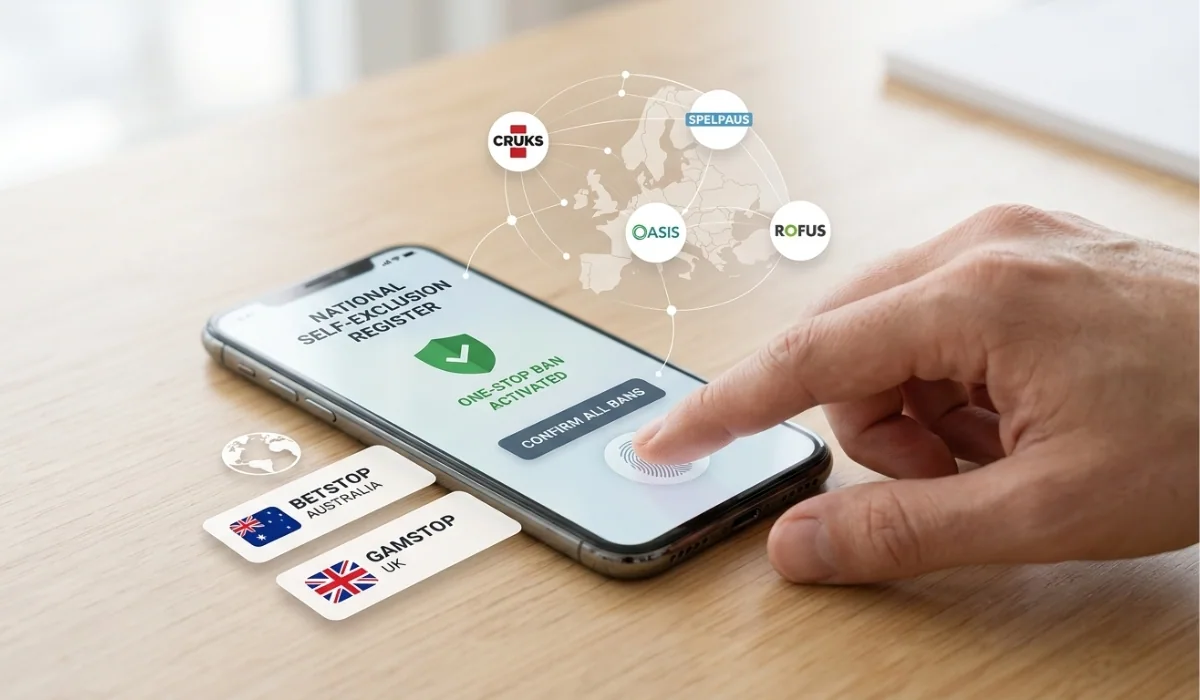
Visiting each casino site for self-blocking is a tedious task that consumes more time, while you have a one-stop solution for blocking gambling access completely using centralised, state-backed technology.
The National Registry System
The National Registry System works as a supporting arm for managing and breaking your betting habits or gambling addiction. With the National Registry System, also known as the National Self-Exclusion Register, you can ban yourself legally and voluntarily from all the licensed casinos and betting sites by placing a single request.
BetStop Australia: How To Instantly Block All 150+ Licensed Aussie Sites
Many countries have introduced their own tools to break the gambling or betting behaviour of people. In Australia, Bet Stop and GAMSTOP are the most popular tools. BetStop lets you exclude yourself from all the licensed phone and online wagering services in a simple step. Registering at Bet Stop is an easy and simple step.
For the registration, all you need to have is an email ID, phone number, and either a medicare card or a driver’s license. The service is free, and all your personal data is ensured complete privacy and security.
While registering to BetStop, you will be prevented from using almost 150 licensed wagering providers in Australia. You will be removed from the register within 7 days after receiving the application.
GAMSTOP UK: Activating The National Database Shield In Under 24 Hours
GAMSTOP is another popular national registry system that helps in managing and breaking your gambling or betting habits. This tool is specifically meant for casinos in the UK. With GAMSTOP, you can block yourself from accessing gambling operators licensed in Great Britain.
The registration process is simple and takes only a few minutes to complete. Once you submit the request, the block may take up to 24 hours to become active.
By registering, you can choose the time period up to which you want to block yourself from accessing the gambling sites. The key highlight of the platform is that it has helped thousands of people who have struggled with betting behaviour and gambling activities.
European Exclusion Networks: Registering On CRUKS, Spelpaus, OASIS, And ROFUS Systems
Several countries across Europe established gambling exclusion systems, for example, Finland’s Peluuri, the Netherlands’ CRUKS, Sweden’s Spelpaus, Belgium’s EPIS, Denmark’s ROFUS, and Germany’s OASIS.
The Multi-Platform Ban
When you register with the self-exclusion system, your details are entered into the centralised exclusion database, which is shared across the licensed gambling operators within that specific jurisdiction.
Once you are done with registration, the licensed operators cross-check their database with the exclusion register using the personal identifiers like your legal name, phone number, date of birth, and email address.
When they find a match, the gambling account linked to your personal ID will be suspended or permanently closed. This will prevent you from accessing the gambling sites licensed in that country.
Once registered, the block will be activated within the stipulated time period, generally within 24 hours. The operators will bar you from creating new accounts or multiple accounts under different names to access the licensed gambling platforms.
The ACMA Enforcement Angle: How Regulators Penalise Casinos That Violate Registry Bans
The ACMA Enforcement Angle
The regulators, like ACMA, conduct strict auditing to ensure the compliance of operators with self-exclusion rules. The operators must immediately close the accounts flagged by centralised registries.
In case of failure, for each violation, the operators will be penalised a huge amount. If the operator repeats the violation, then their licence may be revoked, and they may face further regulatory scrutiny.
As a result of these strict legal and financial consequences, the casinos take immediate action to suspend or close the account of the player once a match is found.
The 4-Step “Iron-Clad” Casino Account Deletion Protocol
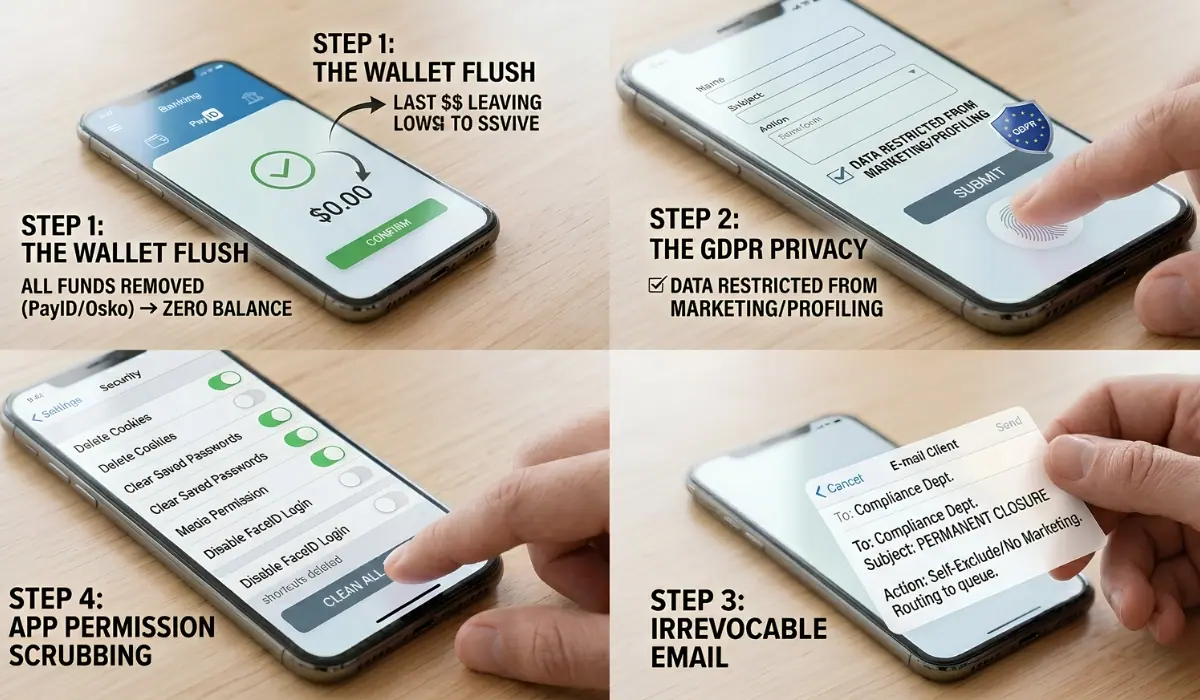
Walking away from a casino is a difficult task, which requires a strategic approach. The casinos are generally built to keep you engaged and retained through rich features and offers. Therefore, a mere deletion is inadequate to wipe out the account completely. Here are some of the major steps that help you to achieve a clean break from gambling platforms.
Step 1: The Wallet Flush: Emptying Leftover Funds via Fast Real Time Payout Rails
If you have active transactions, pending bets, or fund leftovers, the operators may not be able to close the account fully. Make it zero so that the account can be closed easily without any financial complications.
Step 2: The GDPR Privacy Right Request: Forbidding Internal Profiling And Targeted Ads
Although the operators may retain your data for legal reasons like anti-money laundering, they cannot use it freely for tracking your behaviour, promotions, targeted advertising and internal profiling. As a result, your exposure to gambling platforms can be reduced.
Step 3: The Irrevocable Email Template: Routing Your Request Straight To The Compliance Queue
“Subject: PERMANENT ACCOUNT CLOSURE – [Account ID] I am requesting the immediate and permanent closure of my account under your Responsible Gambling policy. I am choosing to permanently self-exclude. Do not offer incentives to reopen, and remove my details from all marketing databases immediately.”
Step 4: App Permission Scrubbing: Deleting Cookies, Saved Passwords, And Biometric Logins
Summary Checklist: The Ultimate Punter’s Clean Break Audit
Make sure that your gambling account is zero and that no pending bets or transactions exist. If your account still carries funds, the operator may not be able to close the account fully.
Instead of simply citing “close account”, use the strong phrase “Permanent Self-Exclusion” when drafting an email to the support team for closing the account.
Register with your country’s self-exclusion system to block yourself from all the licensed gambling platforms.
Make sure that the operator has flagged your email and phone number as “Do Not Contact” in their internal CRM. This prevents you from receiving promotional messages, gambling advertisements and SMS.
To comply with anti-money laundering requirements, the operators retain your financial KYC data for a period of 5-7 days even after closing the account.